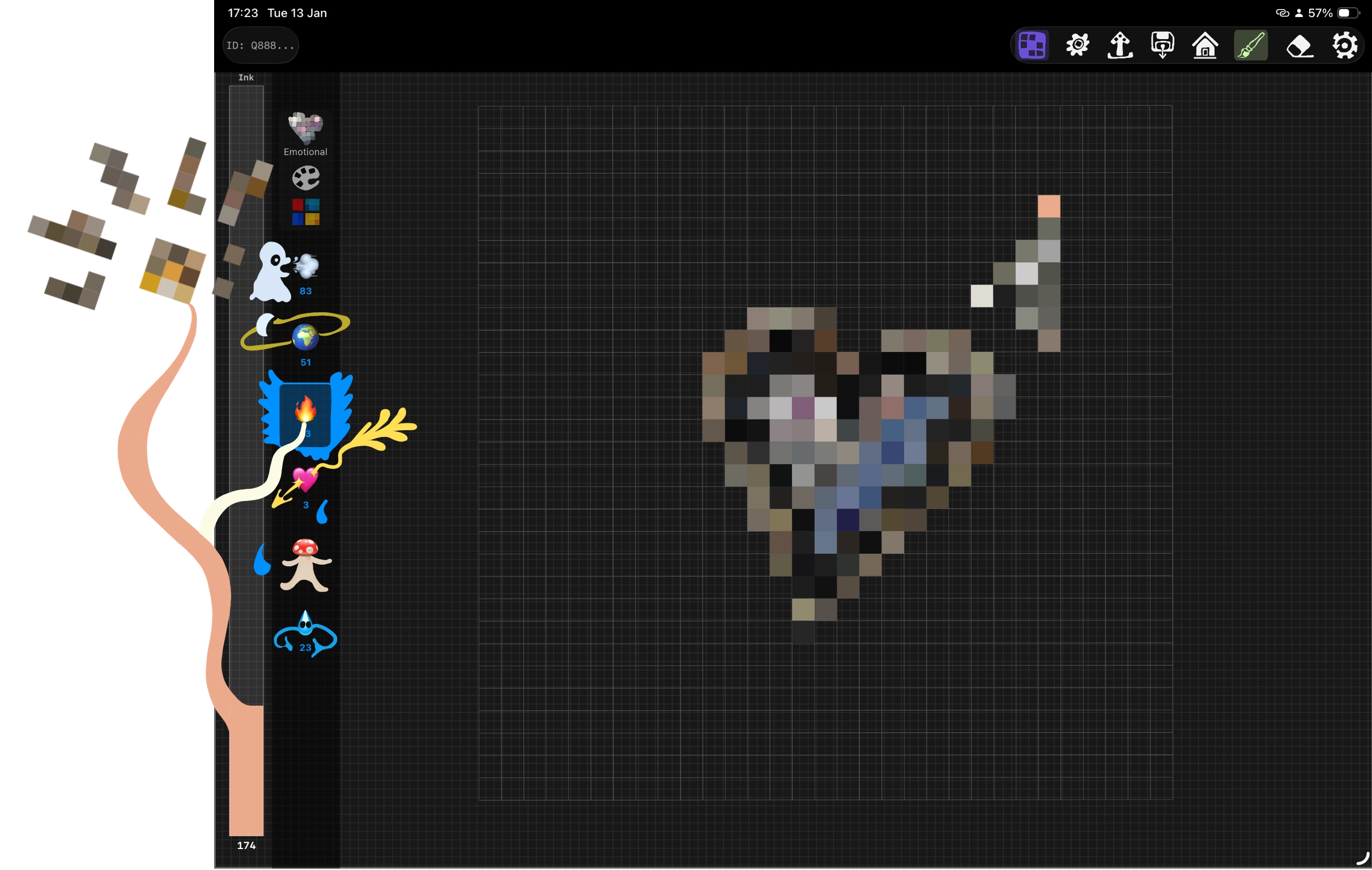
Start with an image that means something to you. A photograph, a drawing, something you found or made. In Digital Ink, it can continue in another form: as a colour you can draw with, carrying traces of where it came from.
I call this material a Smart Ink: one colour, a finite supply and a growing record. You can draw with it, introduce it to new concepts and explore its connections with other Inks.
Digital Ink is an experimental iPad drawing app, and also an art world I am building inside it. I wanted digital material to feel less disposable — more like something we might care for.
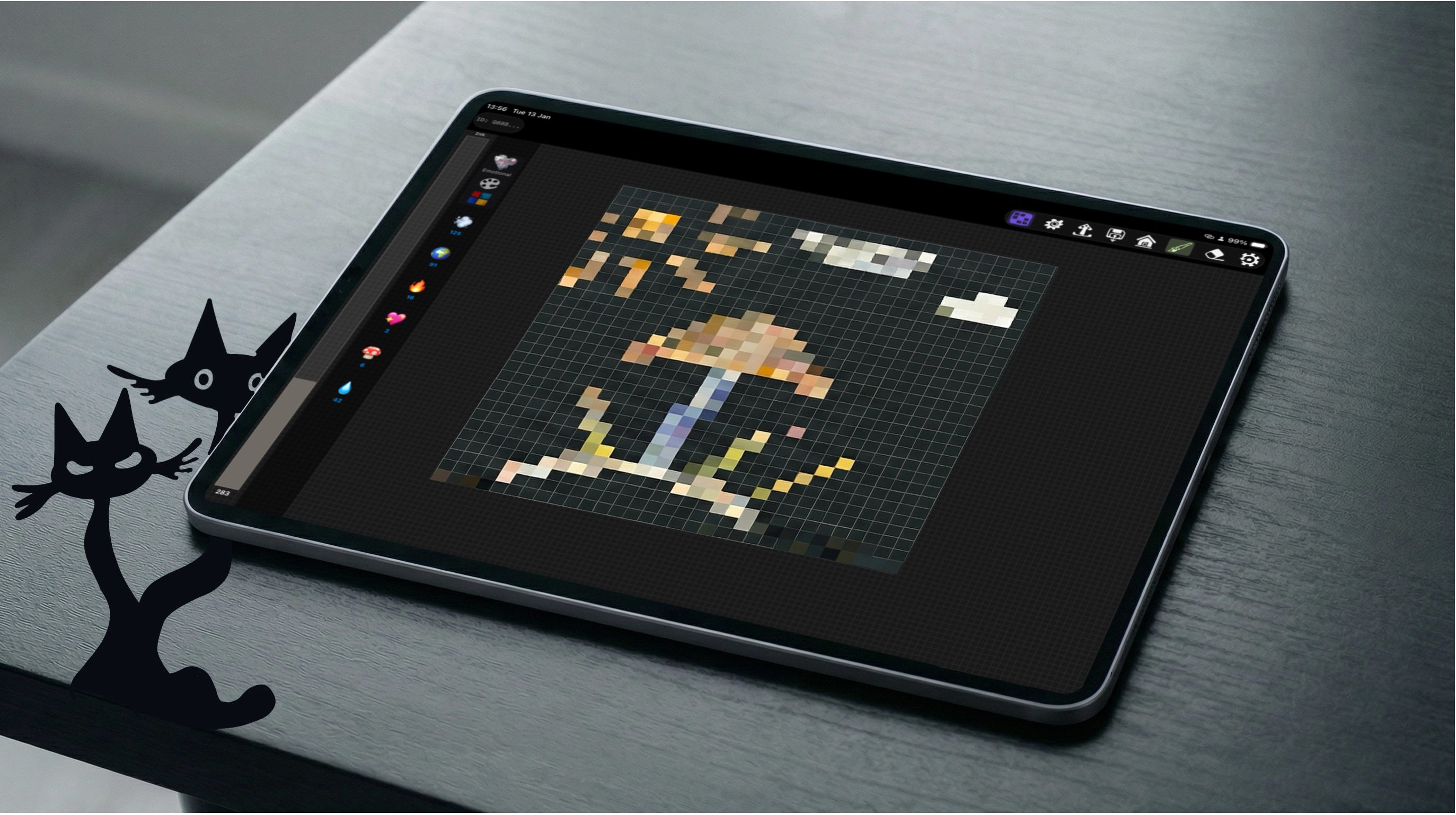
Digital Ink on my studio iPad. The drawing is made with finite Smart Inks.
The artwork is made from pixels, but the pixels are no longer empty.
The moving background is an AI-generated artistic imagining of this world.
Giving a colour somewhere to come from
When I choose a colour in ordinary drawing software, I can use as much of it as I like. It has no particular origin, and the next time I choose it, nothing needs to have changed. Digital Ink began with a curiosity about what that freedom leaves out.
What if choosing a material also meant choosing a past? An image becomes one Smart Ink with a recorded origin. Drawing spends some of its finite supply; erasing can return material. Each placed pixel stays connected to its source Ink, so a mark has a history as well as a colour.
I am interested in what digital material can carry beyond its appearance: learned concepts, personal notes and relationships that continue beyond a single picture. Knowing those histories can change how I use a colour, even when the colour itself stays the same.
Image
Smart Ink
InkHome
Canvas
Artwork
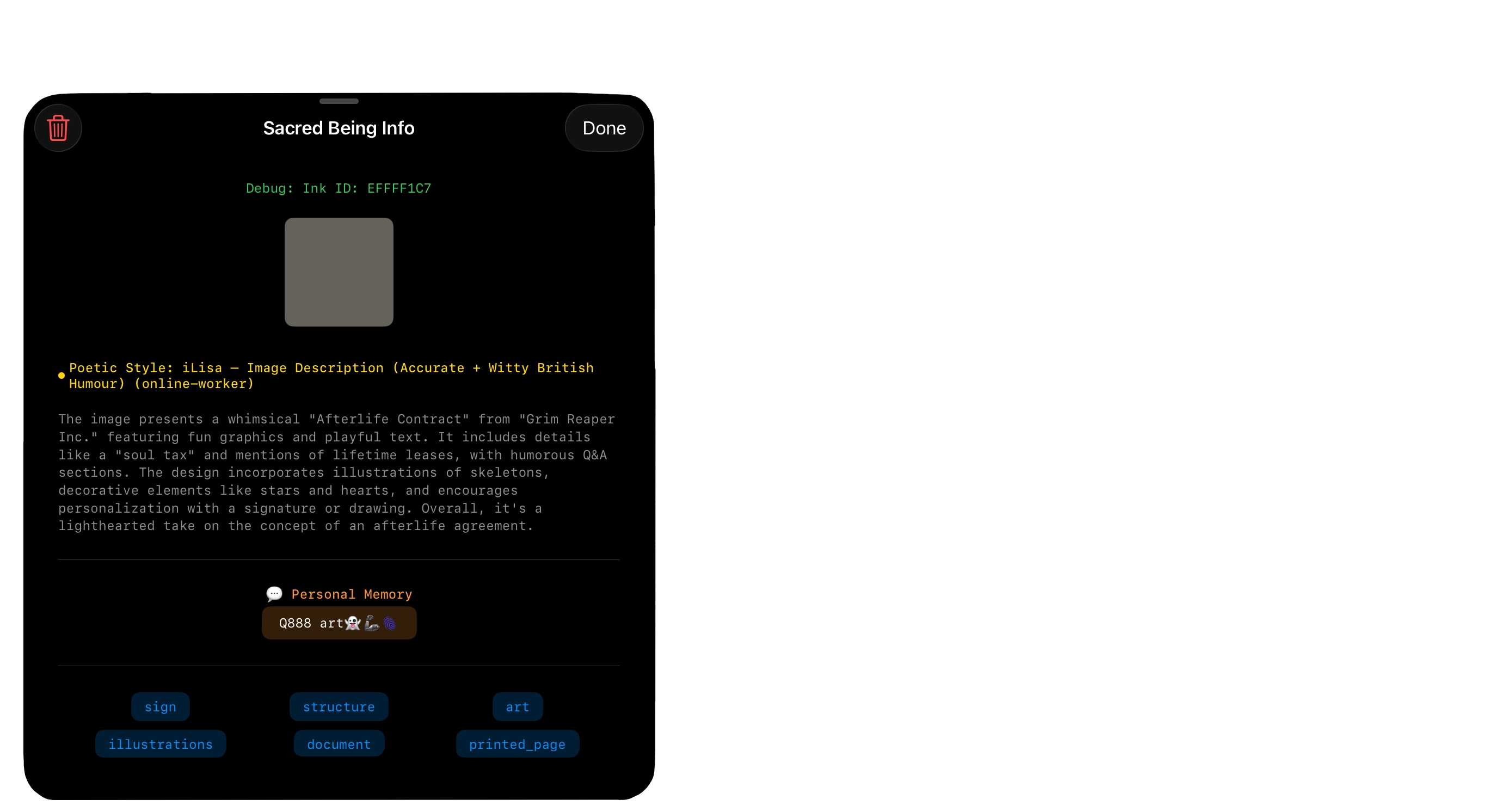
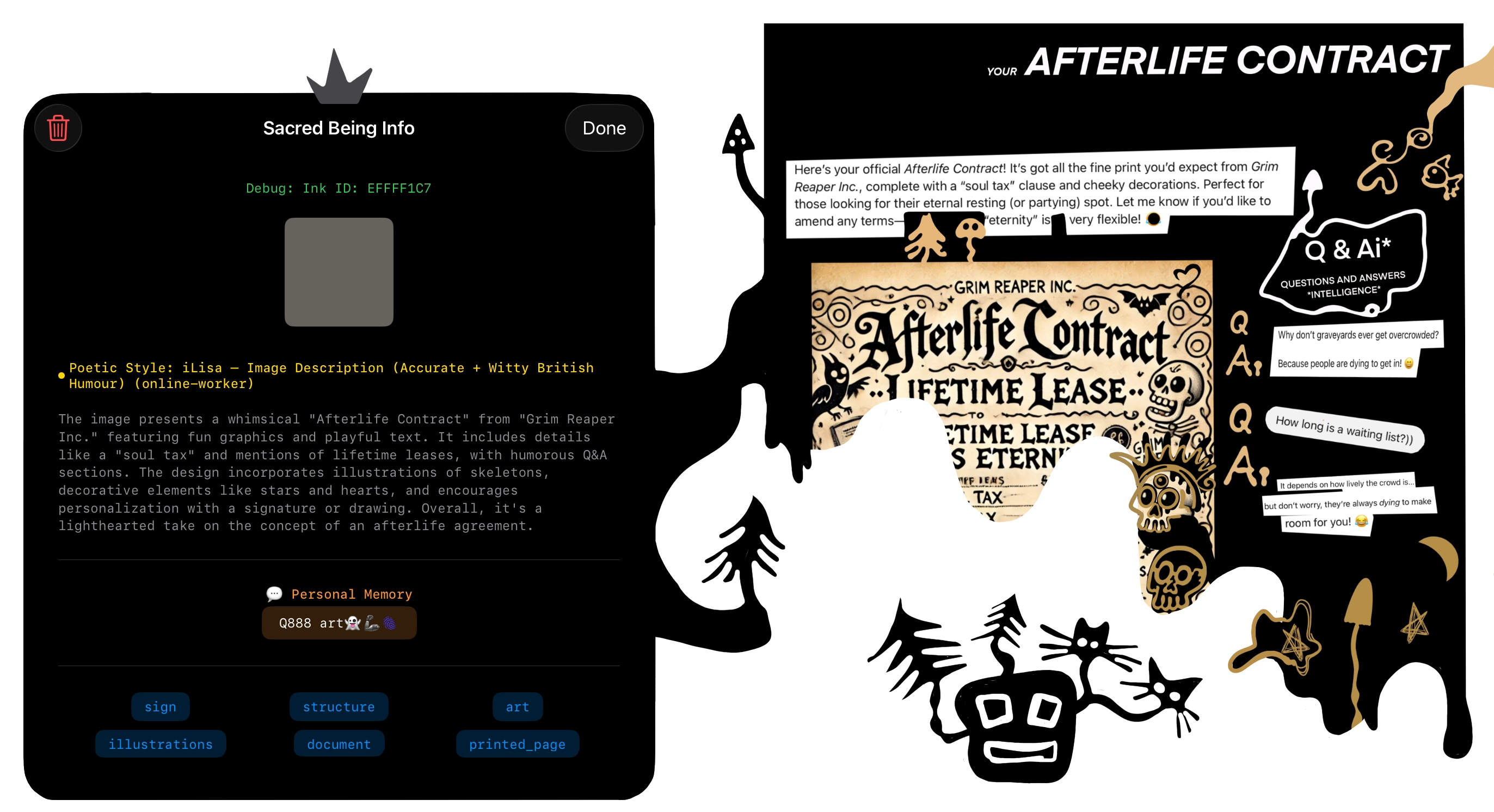
The Ink below began with an Afterlife Contract from another part of my practice. Its biography brings together a machine description, my own note and learned concepts. Each offers a different trace of the source.
A description can misread the image. A personal note can remember something the image never showed. Keeping those traces distinct matters to me: an Ink’s past can grow without being rewritten into one convenient story.
One Ink · a biography from the studio
An Afterlife Contract, remembered as colour, description and learned concepts.
What I remember is not what I was. It is what happened to me.DESCEND THROUGH MY MEMORY ↓
I REMEMBER … being many pixels…
A moment from building and using Digital Ink, drawn back into its interface. As you scroll, the app and my interpretation move over one another.
Following an Ink through the world
There are three spaces in Digital Ink: a place to explore the materials, a place to draw with them, and a place to see the finished work.
InkHome
InkHome gives the archive a spatial form. You can explore Inks together, read their biographies, introduce new concepts through School and see their recorded connections.
A connection can become active, dormant or historical without erasing its earlier state. Inks can also remain unconnected. Their histories have a place here beyond the next drawing.
Canvas
On the Canvas, you become the artist. You choose which Inks to bring together and where their pixels will go. This is the part where you can simply enjoy making an image.
The materials arrive with histories of their own. You compose the picture; knowing where an Ink came from may influence how you use it. A drawing can become a meeting between those histories, if that is how you choose to see it.
The Canvas · an artist’s interface study
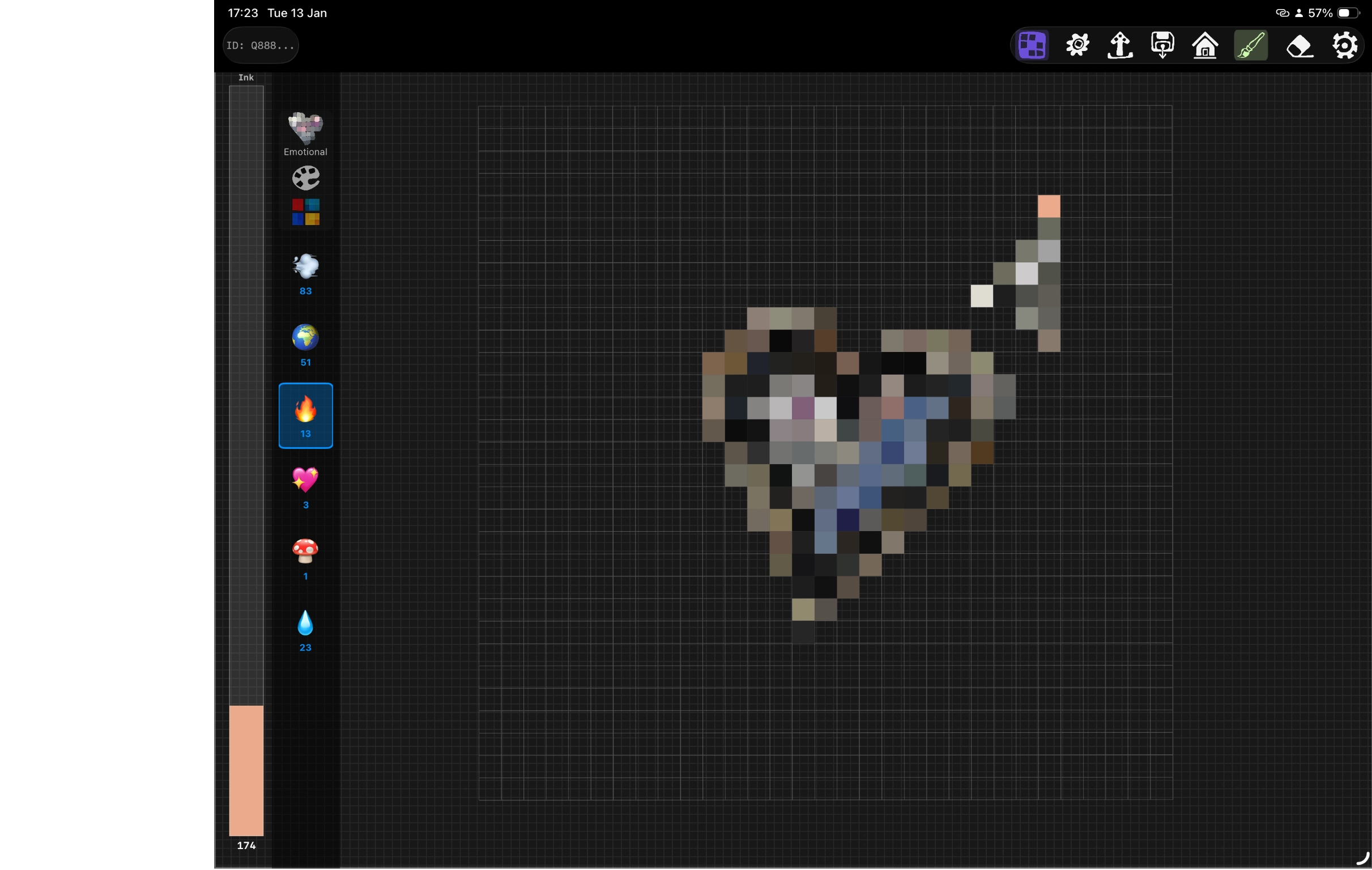
A moment from the app, with another drawing growing around it.
I have 174 pieces left. I am not a colour picker.BRING ME TO THE CENTRE ↓
I kept the date, unfinished details and occasional mistakes as part of the project’s history. The drawn roots are my interpretation of the materials’ connections.
Gallery
When you finish a work, it enters the Gallery and the image becomes quiet again. You can look into the Inks that made it and follow their histories, or simply spend time with the picture.
Here, interpretation belongs to the person looking. The system can show how a work came together; what it means remains open.
Leaving room for interpretation
I choose the Inks and arrange the artwork. Their histories and relationships are real parts of the software; the artistic value I find in them is my interpretation. Knowing an Ink’s past can change how I relate to it, but that does not prove it has an intention of its own.
Digital Ink provides the record, not the conclusion. The relationship an artist develops with these materials remains personal, and what it might become is still open.
What an Ink can carry
An Ink can hold traces of its source, a machine description, personal notes, learned concepts and relationship history. Keeping them separate matters: a machine guess, a personal note and a recorded fact should not quietly become the same thing.
I use words such as memory, education and relationship for these artistic and computational structures. The Inks are not presented as conscious beings. Imagination has a place here too: an AI reconstruction is a new invention, never a recovered photograph.
Letting the work continue
Digital Ink is both an artwork and a place where further artworks can happen. New experiments can draw on the Inks’ existing histories without rewriting them.
Canvas Voice
Current experiment · in development
Could a drawing briefly speak through the histories of its materials? Canvas Voice explores exchanges of up to five words each way, shaped by the Inks on the Canvas and the arrangement of their pixels.
Only meaningful, privacy-safe signals would contribute. An Ink may contribute nothing; that absence would not be treated as a failure or as proof of refusal. The voice would be an interpretation of the available data.
The planned session would end without adding the conversation to Ink memory. I want to explore a voice that belongs to a particular encounter, with a traceable basis for each reply and no permanent personality.
116 photographs would become 116 Smart Inks, allowing their histories and relationships to develop as an artwork in their own right. The project remains a proposal; its rules would be explored through a small prototype.
You can use Digital Ink simply to make pictures, or to explore authorship, memory, scarcity and the relationships we form with digital materials. The app gives these questions a place to be worked through by making things.
For me, the app remains an open experiment. What happens next is part of the work.
You decide what is shared
Drawing and most Ink information stay on your iPad. Optional online AI features ask permission before sending selected content. Buying credits is not consent to share it.
Digital Ink is a native iPad application built in Swift / SwiftUI. Smart Inks and artworks are primarily stored locally on the device. Online AI operations are optional and permission-based.
App architecture
A native iPadOS application with local Smart Inks, artworks, biographies, education, relationship history and provenance. Optional online operations travel through Digital Ink’s Cloudflare service to OpenAI.
Smart Ink data & source traces
A selected image becomes finite material with a representative colour, identity and recorded origin. An Ink can carry seven kinds of information, with source evidence, personal notes, learned concepts and machine invention kept distinct.
Visible trace
One representative colour: the source image reduced to finite digital material.
Source trace
An optional compressed preview, no larger than 192 pixels on its longest edge.
Machine description
Machine-generated language—including its uncertainty and occasional mistakes.
Place & personal note
Date, place, provenance and the artist’s own note, kept distinct from machine interpretation.
Learned concepts
Concepts encountered through selected texts and PDFs after the ink was created.
Relationship history
Relationships with other inks—including how a connection became active, dormant or historical.
Reconstruction
An AI reconstruction: explicitly an invention, never presented as recovery of the source.
Scarcity / Ink rules
Painting spends finite Ink; erasing can return material. Placed pixels remain connected to their source Ink. Colour, use and recorded history belong to the material rather than an unlimited colour picker.
Education
Selected texts and PDFs can add learned concepts to an Ink. These acquired concepts remain distinct from its original visual description and from personal notes. Education contributes to a developing biography; it is not a claim of consciousness.
Relationships & InkHome
Version 3.0 introduced persistent relationships between Inks. InkHome gives the archive a spatial form, with recorded connections and routes visible in a projected 3D environment. A connection can become active, dormant or historical without silently erasing its earlier state.
Provenance
An artwork can record who made it and which Smart Inks were involved. New artworks can carry stronger cryptographic verification without pretending older Inks always had it. Older records remain marked as Heritage Ink where the original evidence is incomplete.
Privacy / AI & model information
On device · Apple Vision
Apple-provided visual recognition can analyse selected images without credits or an internet connection. Its interpretations may be limited or inaccurate. Local Ink information stays on the device unless you choose a feature that shares selected information.
Optional online · OpenAI
With explicit permission for the operation, selected information travels through Cloudflare to OpenAI. Online Assist costs 1 credit; AI Memory Reconstruction costs 10. Purchasing credits is never treated as consent.
Reconstruction generates a new image. It is an invention, never presented as recovery of the source photograph.
The planned exchange is limited to one to five words each way. A local extraction layer would combine meaningful signals from the Canvas Inks with computational properties such as density and symmetry. It would not use human object recognition to tell the Inks what the drawing represents. An Ink may contribute no signal; silence would not automatically become a filter.
Only the question and a few selected, privacy-safe concepts would reach the language mediator. Source images, personal notes, biographies, locations, identifiers and relationship evidence would stay outside that payload. Temporary records would show how the selected conditions led to each reply.
The intended session record would be discarded on the device when the conversation ends, without changing Ink memory or history. Local deletion does not determine an external service’s retention; that boundary would need to be stated before the feature is offered. These are design boundaries for a feature still in development.
PROPOSED FUTURE RESEARCH EDITION
The 116-Pixel Archive
A proposed research edition in which 116 photographs become 116 Smart Inks. The existing relationship history and InkHome would provide its foundation.
This edition does not yet exist. A small prototype would explore source permissions, interpretation, exchange, forgetting and what visitors may see before the full archive is built.
Current development status
Digital Ink is available on the App Store. Version 3.0 includes relationships, InkHome and Artist Identity. Canvas Voice is an experiment in development; the 116-Pixel Archive remains a proposed research edition.
The film and interface studies on this page are part of the project’s development history. Their recorded states may differ from the current app.